Costumes
Dance Studio Costume Management Without the Spreadsheet
Which dancer needs which costume, in what size, for which routine — and has it made its way back to the family yet? Every studio that runs a recital ends up answering these questions for dozens or hundreds of students at once. Dance Director keeps costume information with the rest of your studio data instead of in a separate spreadsheet someone has to keep updating by hand.
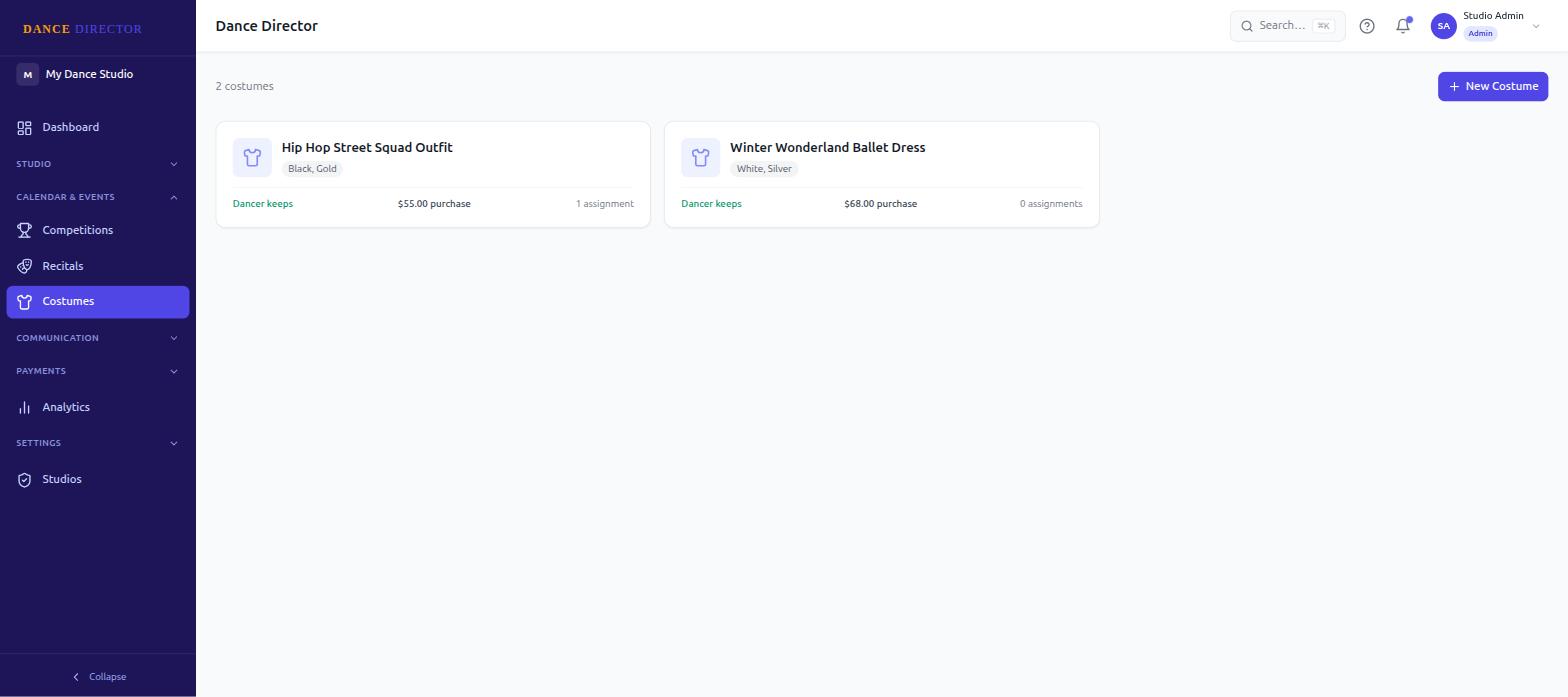
Keep Costume Information With Your Studio Data
A costume tracker that lives outside your student and class records is one more place information can go stale. Dance Director keeps a costume catalog — with images and pricing — right alongside the students and classes it applies to.
- Costume catalog — Build out your available costumes with images and pricing, so staff aren't relying on memory or a folder of photos.
- Price overrides — Adjust pricing for a specific assignment when it doesn't match the catalog default.
Organize Costumes by Student and Class
A costume assignment only means something if it's tied to the right dancer and the right routine. Dance Director connects each assignment to both.
- Costume assignments — Assign a costume to a specific student.
- Recital and competition assignments — Tie the assignment to the recital or competition performance it belongs to, so it's clear which costume goes with which routine.
- Student sizing — Sizing lives on the student's profile, ready whenever a costume is being assigned.
Make Recital Planning Easier
Costumes are one part of a much bigger recital picture — lineups, rehearsals, and communication with families all have to come together around the same performance schedule. Because costume assignments live in the same system as your recital planning, there's one place to check instead of cross-referencing a spreadsheet against a lineup. See dance recital management software for how the whole show comes together.
Stop Maintaining Separate Costume Spreadsheets
Costume billing runs through the same system as tuition and other studio charges — a costume fee doesn't require pulling up a different tool to send a separate invoice. And because costumes are often rented or reused season to season, Dance Director includes return tracking, so studios can keep track of what's come back instead of relying on a memory or a sticky note on the office door.
Costume information staying with the student and recital record — rather than a spreadsheet someone has to remember to update — is the difference between finding an answer in seconds and digging through three files to find it.
Built for the Way Dance Studios Actually Work
General-purpose business software doesn't have a concept of "costume assignment tied to a recital performance" — because it isn't built for dance studios. Dance Director is. Costume management sits next to your classes, students, billing, and recital planning because that's how the work actually happens at a dance studio. See the full list of Dance Director features for how it all fits together, or read about recital ticketing for the other side of show season.
Frequently Asked Questions
Can I track which costume each dancer needs?
Yes. Costumes can be assigned to individual students and tied to the recital or competition performance they belong to, so each dancer's costume assignment is on their record.
Can costumes be billed to families?
Yes. Costume billing runs through the same system as tuition and other studio charges, so a costume fee doesn't require a separate invoice outside of your normal billing.
Can I track costume sizes?
Yes. Student sizing is kept on the student record, so it's available whenever a costume is being assigned or ordered.
Are costumes connected to recitals and competitions?
Yes. Costume assignments can be tied to a specific recital or competition performance, keeping the costume record connected to the routine it's for.
Can I track costume returns?
Yes. Dance Director includes return tracking for costumes, so studios that rent or reuse costumes can keep track of what's come back.